
What a Funeral Pre-Arrangement Document Includes

A funeral pre-arrangement document has two parts: a written prepaid contract (if you are funding arrangements in advance) and a personal funeral wishes checklist. Together, they give your family and chosen agent everything needed to carry out your wishes and access funds without confusion.
The legal contract side must include, at minimum:
- An Itemized Statement of Funeral Goods and Services listing every item and its price
- A General Price List, which the FTC Funeral Rule requires funeral homes to provide
- A clear disclosure of whether the contract is guaranteed or non-guaranteed
- The name of the trustee or insurance carrier holding prepaid funds
- Cancellation and refund terms, plus signatures and dates
The personal wishes side should capture your full legal name, primary and alternate contacts, disposition choice (burial, cremation, or aquamation), service preferences, officiant details, and a map to key documents like your will and life insurance policy.
Bravo Family Mortuary offers transparent, all-inclusive preplanning for San Diego families, with no hidden fees and online arrangements available 24/7 through the PartingPros portal.
Table of Contents
- What federal and state rules require in a prepaid funeral contract
- What to include in your personal funeral wishes document
- How payment and funding are documented in a pre-need plan
- A one-page template you can fill out today
- Where to store your pre-arrangement paperwork
- What to ask and watch for before you sign
- Key Takeaways
- Why the paperwork matters more than most families expect
- Bravo Family Mortuary is ready to help you preplan with clarity
- Authoritative sources for further reading
What federal and state rules require in a prepaid funeral contract
U.S. law sets a clear floor for what a formal pre-need contract must contain. The FTC Funeral Rule requires funeral providers to give consumers a General Price List and an itemized statement of every good and service selected. Vague package pricing without line-item detail is not compliant.
Beyond federal rules, state pre-need laws add further protections. California’s Cemetery and Funeral Bureau, for example, recommends consulting an attorney before signing and confirms that contracts must be in writing to carry legal weight.
Every compliant prepaid contract should include:
- Itemized Statement of Funeral Goods and Services Selected — with individual prices
“Funeral providers must give you an itemized price statement for the funeral arrangements you select. The statement must list the price of each individual funeral item and service you are considering.” — FTC Funeral Rule guidance
Pro Tip: Ask specifically who holds the funds and whether interest earned in the trust is taxable to you or the funeral home. Some states require the funeral home to pay taxes on trust interest; others pass that obligation to the buyer. Knowing this upfront prevents a surprise bill.
For a plain-language breakdown of how to read contract language, Bravo Family Mortuary’s guide on funeral home contract contents walks through each clause in plain terms.
What to include in your personal funeral wishes document
A personal wishes document is not a legal contract, but it may be the most useful thing you leave behind. It tells your family exactly what you want, names the person authorized to make decisions, and points them to every document they will need. A comprehensive end-of-life plan should cover identity, contacts, disposition, service preferences, and a paperwork map.
Identity and contacts:
- Full legal name, date of birth, and Social Security number (if comfortable including it)
- Primary contact and two alternates
- Designated agent or decision-maker, plus a backup if the primary is unavailable
Disposition and service:
- Burial, direct cremation, aquamation, green burial, or other preference
- Cemetery name and plot number, or urn and placement wishes
- Service type: graveside, chapel, celebration of life, or private
- Preferred location and officiant name and contact
Ceremony details:
- Music selections and readings
- Pallbearers and eulogists by name
- Obituary wording, preferred photo, and charitable donation or flower instructions
Paperwork map (record where each document is stored):
- Will and trust documents
- Life insurance policies and policy numbers
- Prepaid funeral contract number and funeral home contact
- Cemetery deed or cremation permit
- VA paperwork for veterans
- Digital account access via a password manager (note the manager’s location, not the passwords themselves)
A funeral planning form maps these fields directly to the U.S. Standard Certificate of Death, which means accurate personal data here prevents delays in death certificate processing.
Pro Tip: Name at least one backup decision-maker. If your primary agent is traveling, incapacitated, or simply unreachable in the first 24 hours after a death, a named alternate keeps arrangements moving. Also state your organ or body donation intention explicitly — verbal conversations are not enough.
How payment and funding are documented in a pre-need plan
Payment documentation must identify who holds the funds, on what terms, and what happens to the money if you cancel or if the funeral home closes. A step-by-step funeral plan guide stresses listing prepaid contract details and insurance policy information so survivors can settle affairs quickly.
The three most common funding methods:
- Funeral trust: funds deposited into a state-regulated trust account; interest may be taxable
- Insurance assignment: a life insurance policy assigned to the funeral home to cover costs at death
- Payable-on-death (POD) account: a bank account that transfers directly to the funeral home upon death
The guaranteed vs. non-guaranteed distinction matters most when prices rise between the time you prepay and the time of death.
| Contract type | Price at time of death | If trust balance differs from cost |
|---|---|---|
| Guaranteed | Locked at today’s price | Funeral home absorbs any shortfall |
| Non-guaranteed | Current price list applies | Family pays the difference, or receives a refund if balance exceeds cost |
“Only the person who made the arrangements can change them before death. Portability and cancellation rights must be documented in the contract.” — California Cemetery and Funeral Bureau
Before signing, verify each of these in writing:
- Trustee name, contact, and state license number
- Whether the plan is fully guaranteed
- Transfer or portability rules if you move out of state
- Cancellation penalties and refund timeline
- Who pays taxes on trust interest
- What happens to funds if the funeral home closes or is sold
For a clear picture of how online prepayment flows work, Bravo Family Mortuary’s guide on online funeral payments explains each step.
A one-page template you can fill out today
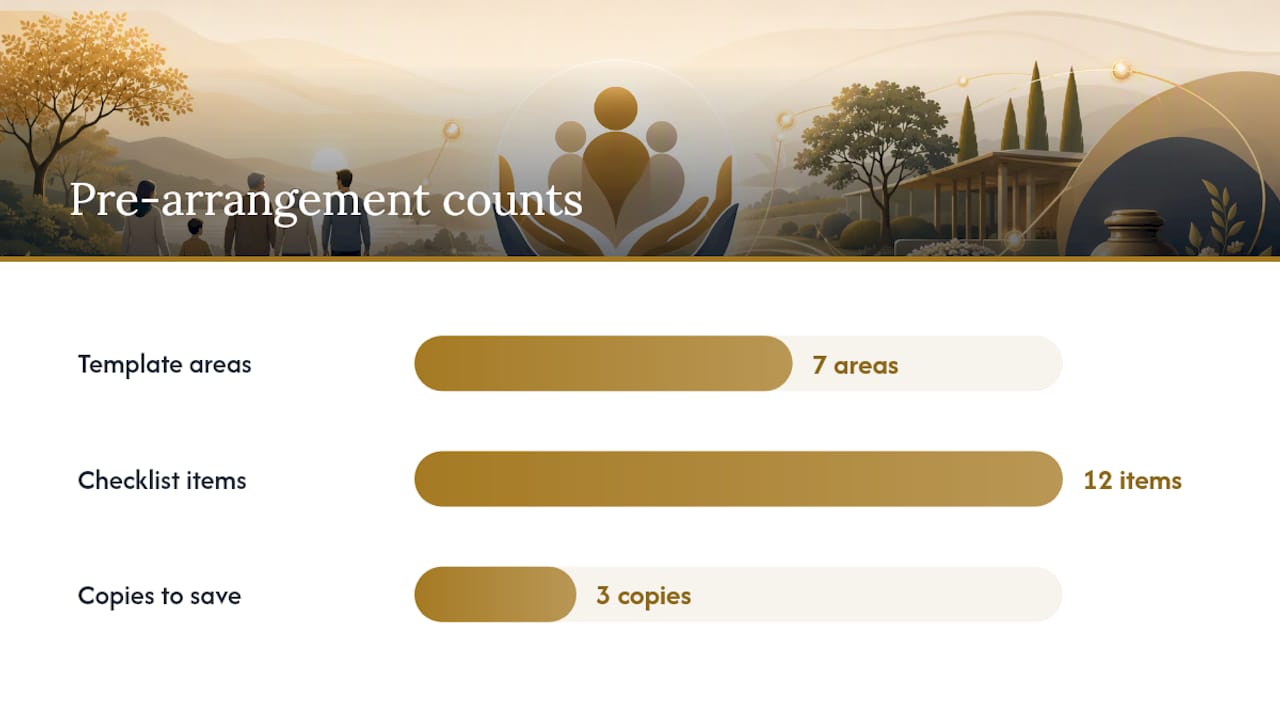
A practical pre-arrangement template covers seven areas. Fill in what you know now and update it annually.
- Personal details: full legal name, date of birth, Social Security number, birthplace
- Designated agent: name, phone, email, and relationship; backup agent with same details
- Disposition choice: burial / direct cremation / aquamation / green burial / other
- Service preferences: type, location, officiant, music, readings, pallbearers, eulogists
- Prepayment information: contract number, funeral home name, trustee or insurer contact
- Organ and body donation: yes/no, registered organization, donor registry confirmation
- Document storage location: where originals are kept and who has copies
Printable checklist (keep this with your documents):
- Full legal name and date of birth confirmed
- Social Security number recorded
- Designated agent named, backup agent named
- Disposition choice stated in writing
- Service type and location noted
- Officiant and ceremony details recorded
- Prepaid contract number and trustee contact listed
- Life insurance policy numbers recorded
- Will and trust location noted
- Cemetery deed or cremation permit location noted
- Organ/body donation intention stated
- Document storage location shared with agent and executor
Save one copy with your will, give one to your designated agent, and leave one with your funeral home. A funeral planning form aligned to the U.S. Standard Certificate of Death is a reliable starting point for the personal details section.
Where to store your pre-arrangement paperwork
Keep the original contract in a secure, accessible place — not a safe deposit box that requires a court order to open after death. Give certified copies to your designated agent, your executor or attorney, and the funeral home.
Practical storage options:
- Funeral home file — (Bravo Family Mortuary keeps preplanning documents on file for San Diego families)
Share copies with your primary contact, two alternates, your attorney or executor, and the funeral home. Never write passwords inside the document itself. Instead, note the name and location of your password manager so your agent can access digital accounts.
Pro Tip: Label the folder or envelope clearly: “Funeral pre-arrangement — please present to funeral director.” Include a one-page cover letter listing your name, contract number, trustee contact, and the names of your designated agent and backup. This single page can save your family hours of searching.
State guidance from the California Cemetery and Funeral Bureau also recommends recording where originals and copies are stored as part of any written preneed plan. For families managing arrangements remotely, Bravo Family Mortuary’s guide on remote funeral planning explains how documents can be shared and confirmed digitally.
What to ask and watch for before you sign
Verify these six things in writing before signing any pre-need contract:
- Who holds the funds, and what is their state license number?
- Is the plan fully guaranteed, and what does that cover exactly?
- Can the contract transfer to another funeral home if I move?
- What fees or penalties apply if I cancel?
- Who pays taxes on interest earned in the trust?
- What happens to my funds if the funeral home closes or is acquired?
Red flags worth pausing for:
- Vague trustee language with no named institution
- Refusal to provide an itemized Statement of Funeral Goods and Services
- Pressure to purchase packages without line-item pricing
- No written answer to cancellation or portability questions
“If a funeral provider refuses to give you a General Price List or an itemized statement, that is a violation of the FTC Funeral Rule. Stop, ask for written answers, and consult your state’s consumer protection office before proceeding.” — FTC Funeral Rule
The California Cemetery and Funeral Bureau’s pre-need Q&A confirms that portability and cancellation rights must appear in the contract itself, not just in verbal assurances. Bravo Family Mortuary’s guide on comparing funeral home prices also walks through how to evaluate itemized statements side by side.
This article is general information, not legal or financial advice. Confirm current state pre-need rules with your state’s cemetery and funeral bureau or a qualified attorney.
Key Takeaways
A complete funeral pre-arrangement document requires both a legally compliant written contract with itemized pricing and a personal wishes checklist naming your agent, disposition choice, and document locations.
| Point | Details |
|---|---|
| Written contract is required | Federal law (FTC Funeral Rule) requires itemized pricing and guarantee disclosure in every prepaid contract. |
| Guaranteed vs. non-guaranteed matters | A guaranteed plan locks today’s price; a non-guaranteed plan may leave your family with a balance due. |
| Personal wishes need a backup agent | Name a primary and alternate decision-maker so arrangements can proceed if the first contact is unavailable. |
| Store documents accessibly | Keep originals in a home safe or with your attorney, not a safe deposit box that requires a court order to open. |
| Bravo Family Mortuary preplanning | Bravo Family Mortuary offers transparent, online preplanning via PartingPros and keeps documents on file for San Diego families. |
Why the paperwork matters more than most families expect
Most people assume a conversation with a family member is enough. It rarely is. When a death occurs, the people making decisions are often grieving, sleep-deprived, and facing a funeral home for the first time. A clear, written pre-arrangement document removes the guesswork entirely. It tells the funeral director exactly what was chosen, confirms who is authorized to make changes, and points the family to every financial document they need.
What gets overlooked most often is the backup agent. Families name one person and stop there. But if that person is traveling internationally, hospitalized, or simply in shock, arrangements can stall for hours. A named alternate, clearly listed in the document, costs nothing and prevents real delays.
Bravo Family Mortuary’s bilingual team in San Diego has seen firsthand how a single organized folder, handed to a funeral director on the first call, changes the entire experience for a family. Transparent pricing, no hidden fees, and a document already on file means the family can focus on each other rather than on paperwork.
Bravo Family Mortuary is ready to help you preplan with clarity
Preplanning with Bravo Family Mortuary means your documents are on file, your family knows exactly what was chosen, and there are no surprises on pricing. As a family-owned funeral home serving all of San Diego County 24/7, Bravo Family Mortuary publishes all-inclusive pricing openly, so you can review costs before any conversation begins.

Services available for preplanning include direct cremation, aquamation, traditional burial, green burial, cremation with memorial service, celebration of life, and military and veteran funeral services with VA benefits coordination at no additional charge. Spanish-speaking families receive the same full care and documentation support in their preferred language.
Start a secure preplanning session anytime through the PartingPros portal at bravofamilymortuary.com/preplanning, view funeral and cremation services online, or call for a calm, no-pressure conversation. We are here whenever you are ready.
Authoritative sources for further reading
| Source | What it covers |
|---|---|
| FTC Funeral Rule | Federal disclosure requirements: GPL, itemized statements, guaranteed vs. non-guaranteed |
| California Cemetery and Funeral Bureau (Q&A) | State pre-need protections, written contract requirements, document storage |
| CA Funeral Bureau Pre-Need PDF | Portability, cancellation rights, who may change arrangements |
| LawDepot End-of-Life Plan | Personal wishes template covering identity, contacts, and disposition |
| LegalClarity Funeral Planning Form | Death-certificate-aligned worksheet for personal data and service choices |
| Funeral.com Step-by-Step Guide | Checklist for prepaid contract details, insurance, and paperwork map |
| Bravo Family Mortuary Pricing | Transparent, all-inclusive pricing for San Diego cremation and burial services |
For questions about coroner involvement or medical-legal processes that may affect disposition timing, this overview of coroner responsibilities explains when and how those processes intersect with funeral arrangements.